Why Food Service Professionals Need Accurate Portion Calculations
Running a food business means juggling flavor, quality, and profitability all at once. When we work with restaurants, catering companies, and bakeries, one question comes up constantly: “How do I know if I’m actually making money on each plate?”
Portion guesswork erodes margins silently. A server who pours an extra quarter-ounce of chimichurri on every steak appetizer might think nothing of it, but across 200 covers a week, that’s roughly 50 ounces wasted. At the end of a month, you’ve hemorrhaged inventory and profit that nobody noticed.
Accurate portion calculations do three critical things: they eliminate cost surprises, they help you price dishes confidently, and they give you the data to train your team. When your kitchen staff knows the exact yield they should get from a bottle or container, consistency improves, waste drops, and your cost-per-plate becomes predictable.
Your immediate action: Pull your last three months of food costs and identify where chimichurri and dulce de leche appear. Note the dish names and typical portions served. You’ll use this baseline to build your cost calculator.
Understanding Chimichurri Yields: From Bottle to Plate
Chimichurri’s brightness makes it a natural fit across proteins, vegetables, and grains. But the yield you get depends entirely on how you’re using it.
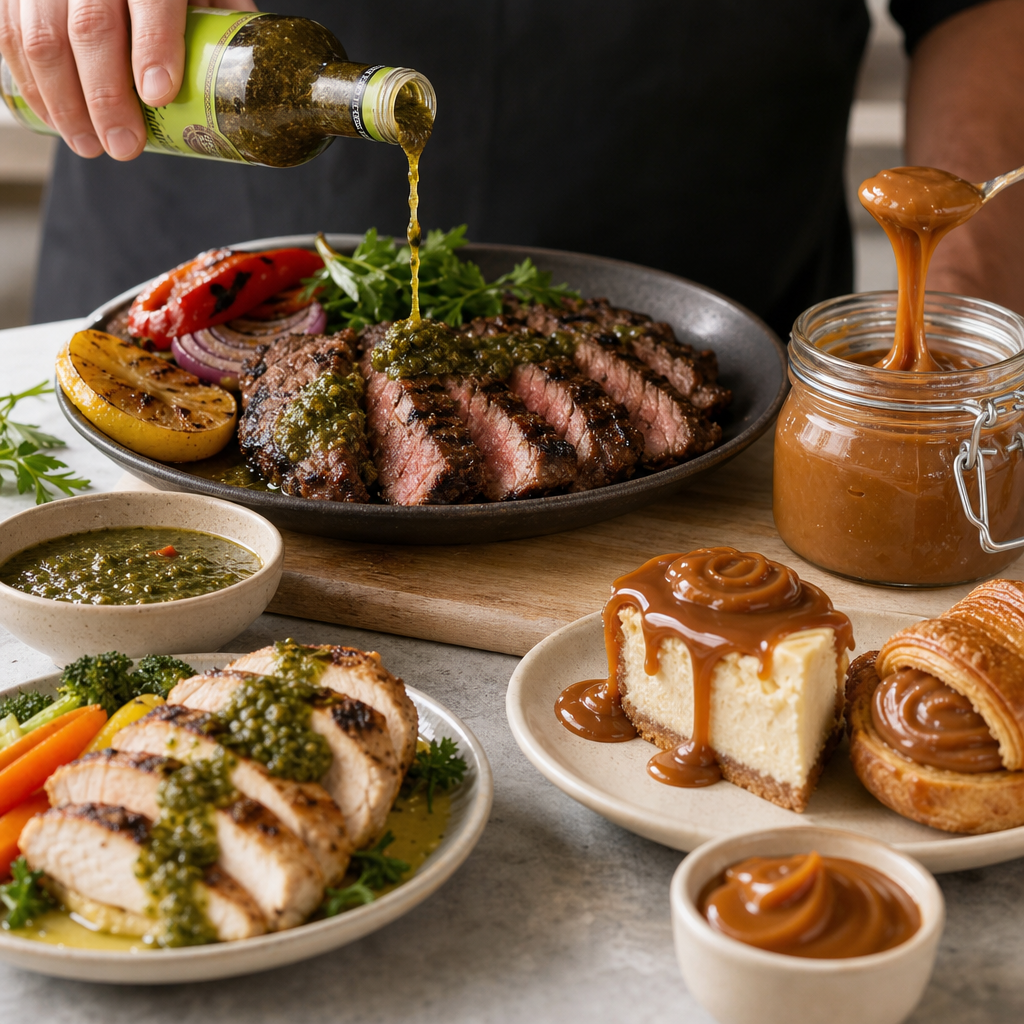
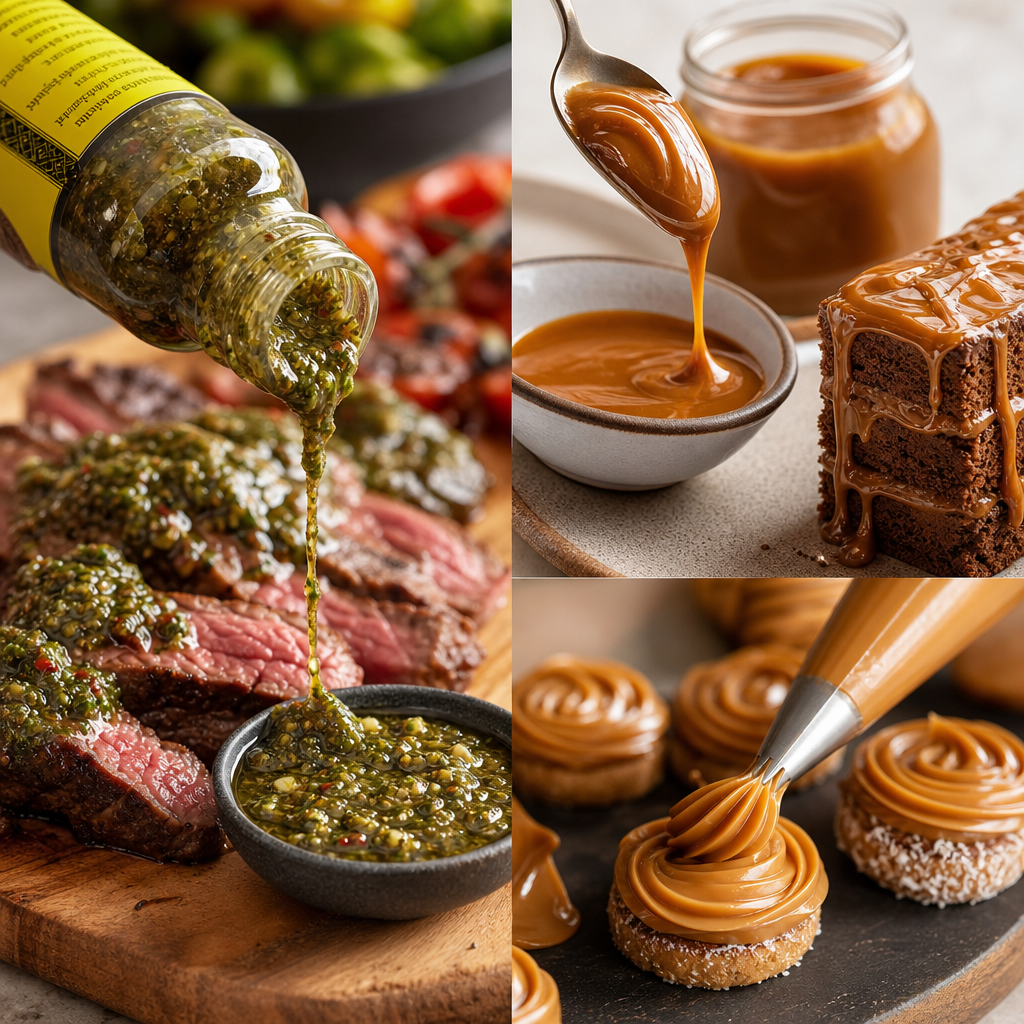
Our chimichurri squeeze bottle comes in 17-ounce sizes for retail, though food service can access larger bulk formats. A typical single serving for plating runs 0.5 to 1 ounce, depending on the dish context. A steak appetizer might receive a bold 1-ounce drizzle, while a vegetable plate gets a lighter 0.5-ounce accent.
The beauty of chimichurri is that it stretches. Many chefs thin it with olive oil at a 1:1 or 2:1 ratio when building house chimichurri sauces. That extends yield without sacrificing the authentic Argentinian flavor profile. A single 17-ounce bottle can yield 25 to 35 plated portions when you’re blending and portioning thoughtfully.
Here’s the practical math: if you’re serving 1-ounce portions of straight chimichurri, one 17-ounce bottle gives you 17 portions. If you’re drizzling 0.5 ounces per plate, that same bottle serves 34 plates. The difference between these scenarios on a 300-cover Friday night is enormous.
Storage temperature affects viscosity too. Chimichurri that’s been refrigerated pours more densely than room-temperature sauce. If your plating standard assumes cold sauce but someone leaves a squeeze bottle out, your portion sizes will creep larger without anyone realizing it.
Actionable step: Portion out your typical single serving into a small ramekin and weigh it. Once you know that a “chef’s standard pour” is actually 0.75 ounces, you can calculate backward to bottles needed per service.
Dulce de Leche Serving Sizes Across Different Applications
Dulce de Leche works differently than chimichurri because applications vary wildly. A spoonful stirred into coffee is 0.25 ounces. A dessert plate presentation might be 2 ounces. A pastry filling requires a totally different calculation than a topping.
We produce dulce de leche in spreadable and pour-able consistencies, each suited to different kitchen uses. The spreadable version works beautifully for layering in cakes or filling empanadas, where you need it to hold shape. The pour-able version is ideal for drizzling over ice cream or into pastry creams.
A 15-ounce container of dulce de leche spreadable can fill approximately 30 to 40 pastries if you’re using 0.35 to 0.5 ounces per piece. For a simple dessert plating like a 2-ounce swirl alongside churros, one container yields 7 to 8 generous portions.
The difference between applications matters enormously for cost-per-plate. If dulce de leche appears as a hidden ingredient (say, swirled into a ricotta filling), your portion is smaller and your per-unit cost drops. If it’s the showstopper on the plate, your portion and cost both increase.
Waste also differs. Spreadable dulce de leche adheres well to spatulas and mixing bowls, so you lose roughly 2-3% to equipment cleaning. Pour-able versions are more forgiving and get used almost entirely. Factor this into your yield calculations.
Concrete example: A bakery making 200 alfajores uses 0.4 ounces of dulce de leche per sandwich. That’s 80 ounces needed, or roughly 5.5 containers of 15-ounce size, plus accounting for that 2-3% loss. Knowing this exact number prevents over-ordering and keeps cash flowing smoothly.
Calculating True Cost Per Plate With Our Products
Real cost-per-plate math includes three elements: product cost, portioning cost, and waste factor.
Start with product cost. If you’re buying a 17-ounce chimichurri bottle for wholesale and your cost is $8, the cost per ounce is $0.47. If you’re serving 0.75 ounces per plate, your ingredient cost for that component is just $0.35. That’s the transparency you need.
Add portioning cost. If you’re paying a line cook $20 per hour and they spend 10 seconds per plate drizzling chimichurri, that’s labor cost embedded in your final dish (though small, it’s real). More sophisticated portioning systems reduce labor waste significantly.
Then factor waste. Industry standard is 3-5% waste on any liquid product due to equipment residue, spills, and trimming. If your chimichurri yield calculation doesn’t account for this, you’re underpricing dishes consistently.
Here’s the formula:
Product Cost = (Product Price / Total Ounces) x Portion Size Waste Adjustment = Product Cost x 1.04 Labor Burden = (Hourly Rate / Portions per Hour) x Portion Factor True Cost Per Plate = Waste Adjustment + Labor Burden
Using our example: ($8 / 17oz) x 0.75oz = $0.35 per portion. Add 4% waste: $0.36. If portioning takes a few seconds per plate, add $0.05 in labor. Your true cost is $0.41 per plate for chimichurri alone.
Most restaurants mark up food costs 3:1 or 4:1 to cover labor, rent, and profit. A $0.41 ingredient cost suggests a menu price of $1.23 to $1.64 for that component. Knowing this gives you pricing power and confidence.
Next step: Build a simple spreadsheet listing each dish, portion size, ingredient cost, waste adjustment, and implied menu price. This becomes your baseline for pricing conversations with management.
Maximizing Profit Margins With Precise Portioning
Precision portioning isn’t about serving small; it’s about serving consistent and building predictability into your food costs.
The challenge most kitchens face is inconsistency. One cook portions chimichurri by sight, another by feel, a third by muscle memory. Across 300 covers a week, this variation can swing your total chimichurri usage 15-20%. That’s 2-3 bottles wasted or revenue left on the table.
Invest in simple tools to standardize portioning. A 1-ounce ladle, squeeze bottles with marked pour lines, or small portion cups eliminate guesswork. These cost $15-40 per tool and pay for themselves in a single shift by preventing over-portioning.
Here’s where margin really grows: when you standardize, you can actually reduce portion sizes slightly without anyone noticing. A plate that received 1.2 ounces of chimichurri from inconsistent pouring can reliably receive 0.9 ounces with precision tools and training. Customers don’t taste the difference (they taste the flavor, which is unchanged), but your cost per plate drops 25%.
Track your usage weekly. If you budgeted 40 ounces of chimichurri for a Saturday service and actually used 52, investigate immediately. Was it busier than expected? Did someone over-portion? Once you identify the driver, you can adjust. This discipline compounds across months into thousands of dollars in recovered margin.
Dynamic pricing also becomes possible. On a slow Tuesday, you might offer a “double chimichurri” upsell at a 1.5x pour for a modest $2 premium. Your ingredient cost is still only $0.50, your margin is healthy, and customers feel indulged. You can’t do this confidently without knowing your base costs.
Immediate tactic: Implement a weekly yield report. Every Monday, document bottles used, number of portions served, and cost per portion. Watch for trends. Most kitchens find they’re over-portioning by 10-15% without even realizing it.
Real-World Yield Examples From Restaurants and Bakeries
Let’s ground this in actual scenarios we see regularly.
A mid-sized steakhouse in Denver serves chimichurri on their grilled lamb appetizer. They plate 8-10 covers of this dish per shift, with a 1-ounce portion of our chimichurri per plate. That’s about 10 ounces per shift, or 60 ounces per week. They order bulk 5-liter containers at $40 each (roughly 170 ounces), which gives them a 2.8-week supply. Their ingredient cost per lamb plate is $0.24, and with lamb cost factored in, they price the appetizer at $18. Margin is healthy, waste is minimal, and they never run out mid-service.
A specialty bakery in Austin makes churros with dulce de leche for dipping. They go through approximately 200 churro orders per week, each with a 2-ounce dulce de leche cup for dipping. That’s 400 ounces weekly, or 57 ounces per day. A 15-ounce container covers roughly one day’s service. They buy 60 containers monthly for $8 each (wholesale), giving them a $0.60 ingredient cost per churro portion. They charge $6 for a churro and dulce de leche pairing, and even with production labor factored in, margins comfortably exceed 60%.
A catering company in Chicago builds custom charcuterie and protein boards for corporate events. They use chimichurri as a finishing drizzle on their signature grilled beef crostini platter. Each 50-person event includes 15-20 beef crostini, each with a 0.5-ounce chimichurri swipe. That’s 10 ounces per event. They charge $300 for the beef crostini component; ingredient costs run $35 (beef, crostini, chimichurri combined). This gives them an 88% gross margin on that line, and the chimichurri is the hero ingredient that commands the price premium.
These examples share a common thread: every operation knows their exact portion, their exact cost, and their exact margin. No guessing. No surprises at month-end accounting.
Benchmark yourself: Which scenario most closely mirrors your operation? Calculate whether your margins align. If they’re significantly lower, precision portioning is your quickest path to improvement.
How Our Packaging Sizes Support Your Cost Goals
We’ve designed our product line with food service economics in mind, not just retail convenience.
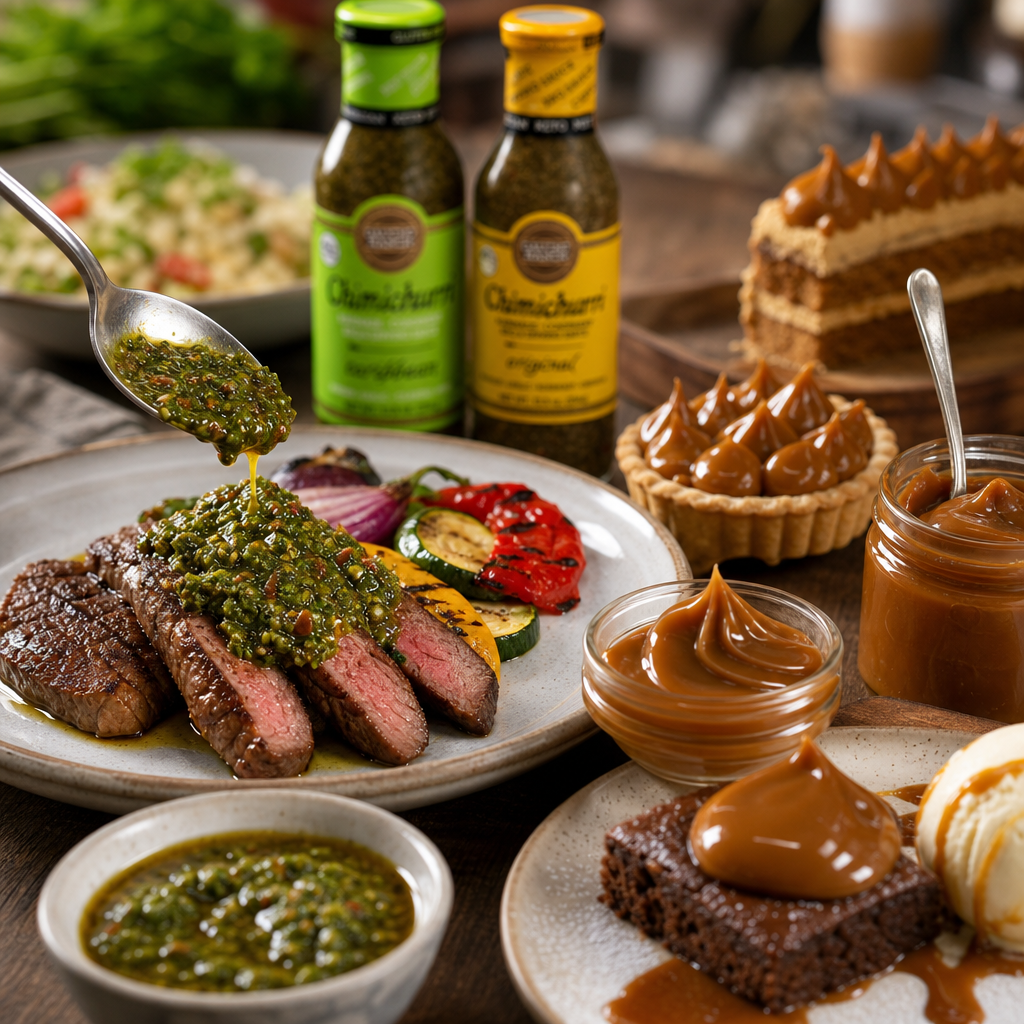
For smaller operations and fine-dining venues, our 17-ounce squeeze bottles offer flexibility and control. You can portion precisely, train staff on consistent servings, and rotate stock easily without volume concerns. The squeeze format also reduces waste because nothing dries out or separates during storage.
For higher-volume kitchens, we offer bulk 5-liter containers of chimichurri and larger dulce de leche formats. The per-ounce cost drops meaningfully at this volume, but the real win is operational simplicity. Instead of tracking 15 small bottles, you track one bulk container. Refilling squeeze bottles or portioning cups from a large container takes 60 seconds and eliminates the need to break down a new bottle every service.
For caterers and meal-prep operations that need intermediate volumes, we can accommodate custom sizes. A 1-liter container, for instance, bridges the gap between retail and full-bulk, giving you the per-unit economics of volume without massive inventory burden.
All our packaging is designed for kitchen efficiency. Squeeze bottles have consistent nozzles that deliver reliable portion sizes. Our containers are stackable to save refrigerator space. Lids seal tightly to prevent oxidation and flavor degradation over time. These practical details compound into lower waste and longer shelf life, which directly improves your cost-per-plate over the lifespan of the product.
We’re also SQF certified and Kosher certified, which matters if your operation has specific regulatory or dietary requirements. That certification is already built into our packaging and processing, so you don’t incur additional compliance costs.
Check your current supply chain: If you’re buying small retail bottles and breaking them down, switching to bulk food-service sizes could reduce your ingredient cost per portion by 15-20%. Calculate the savings over a month.
Temperature and Storage Impact on Product Yields
Temperature management affects both the consistency of your portion and the actual yield you’ll get from a container.
Chimichurri stored at room temperature (68-72F) has a thinner consistency than chimichurri stored cold (34-38F). This matters for portion accuracy. If your portioning standard assumes chilled sauce but you’re pulling from a room-temperature bottle, the sauce pours faster and thinner, resulting in larger portions by volume. Your 0.75-ounce “standard” might actually deliver 0.85 ounces.
For precision, we recommend keeping chimichurri refrigerated until service prep. Chill your squeeze bottles, portion your daily requirement into a service bottle, and use that throughout service. This keeps portions consistent and also preserves the bright herb flavor that makes chimichurri special.
Dulce de leche is more forgiving because it’s denser and changes less dramatically with temperature. However, cold dulce de leche is significantly harder to spread or pour than room-temperature dulce de leche. If you’re filling pastries and need fluidity, warming a container to 55-60F for 15 minutes makes application faster and reduces labor waste from scraping. If you’re doing portion cups for dipping, room temperature or chilled both work fine, but consistency matters for training purposes.
Storage duration also affects yield. Our products have no artificial preservatives, which is great for clean-label positioning but means proper storage extends freshness. Chimichurri stays vibrant for 6 months refrigerated; dulce de leche keeps 12+ months in unopened bulk containers. Once opened, use within 30 days for optimal flavor and consistency. Degraded product sometimes requires discarding, which is pure waste. Rotating stock by FIFO (first in, first out) prevents this.
Track your storage temperature with a simple refrigerator thermometer. Fluctuations above 40F accelerate degradation. If your walk-in runs warm, you’re losing product life and potentially compromising food safety. A $25 investment in a temperature monitor can save hundreds in spoilage over a year.
Practical check: Open your oldest container of chimichurri or dulce de leche. Does the color look muted? Does the aroma seem flat? If yes, your storage temperature may be too warm or stock rotation is inconsistent. Adjust immediately.
Building Your Custom Cost Calculator Spreadsheet
You don’t need complex software. A basic spreadsheet gives you everything needed to track yield and profitability.
Create columns for: Dish Name, Portion Size (ounces), Ingredient Cost Per Ounce, Cost Per Portion, Waste Factor (1.04), Adjusted Cost, Labor Add-On, Total Cost Per Plate, Menu Price, and Margin %.
Start with your current dishes that use chimichurri or dulce de leche. Let’s use a concrete example:
Grilled Steak Appetizer: 1-ounce chimichurri portion. Chimichurri costs $0.47 per ounce. Cost per portion is $0.47. Adjusted for 4% waste is $0.49. Add $0.10 labor for plating. Total cost is $0.59. Menu price is $18. Margin is 96.7%.
Churro with Dulce de Leche: 2-ounce dulce de leche portion. Dulce de leche costs $0.53 per ounce. Cost per portion is $1.06. Adjusted for waste is $1.10. Add $0.15 labor. Total cost is $1.25. Menu price is $6. Margin is 79.2%.
Once you have this baseline, track actual usage monthly. Create a second tab called “Monthly Tracking” where you log bottles purchased, ounces used, number of portions sold, and actual cost per portion. Compare to your standard. Variations of more than 5% warrant investigation.
A third tab can be “Pricing Scenarios.” Ask “what if I increased portions to 1.5 ounces?” and watch your margin shrink. This becomes a negotiation tool with management. When ownership asks why a dish is priced at $18, you can show them the cost breakdown and margin target.
Share these spreadsheets with your kitchen leadership and front-of-house staff (the cost-per-plate summary, not the full financials). When people understand that an extra 0.25 ounces of chimichurri per plate costs the restaurant $150 monthly, portioning discipline improves naturally.
Build this today: Spend 30 minutes creating your baseline spreadsheet for 3-5 core dishes. You’ll have clarity you’ve been missing.
Cost Comparison: Homemade vs Our Ready-Made Solutions
Many kitchens debate whether to make chimichurri and dulce de leche in-house or buy ready-made.
The homemade argument is straightforward: fresh herb flavor and perceived authenticity. Making a batch of chimichurri takes 20 minutes once a week. Dulce de leche requires simmering sweetened milk for hours, though some recipes use shortcuts.
But the economics rarely favor homemade at volume.
Let’s cost out house chimichurri. Parsley, cilantro, garlic, red pepper, olive oil, vinegar, cumin, oregano. If you’re sourcing quality ingredients and making small batches for freshness, your ingredient cost runs roughly $1.20-1.50 per pound, or about $0.38-0.48 per ounce. That’s essentially identical to our cost, but you haven’t factored in labor yet.
A cook spending 20 minutes making a 40-ounce batch at $20 per hour adds $0.11 per ounce in labor. Your house chimichurri now costs $0.49-0.59 per ounce, and it degrades faster because it lacks our natural preservation techniques. You’re paying more and getting less shelf life.
For dulce de leche, the math is even starker. True dulce de leche requires sweetened milk simmered for 2-3 hours (or a pressure cooker method that still demands attention). Labor cost is substantial. If a cook spends 3 hours to yield 30 ounces, that’s $2 per ounce in labor alone. Add ingredients and you’re looking at $2.50-3.00 per ounce, compared to our $0.53 per ounce. The homemade version is five times more expensive.
Where homemade does win is perception. If you can hand-sell “our house-made chimichurri” it might justify a premium. But most customers can’t distinguish house-made from quality ready-made blind. They taste the flavor and the application.
Our approach lets you capture the best of both worlds. You buy premium ready-made products that taste authentic and cost-competitive, then you elevate them in-house. Blend chimichurri with fresh lime and additional herbs. Warm dulce de leche and fold it into fresh cream. Your customers taste handmade care, you control costs, and everyone wins.
Reality check: Time one of your current batch processes. Multiply the time by your average cook wage. Compare that cost-per-ounce to ours. We’re almost always more economical, and if you’re not winning on price, you’re definitely losing on scale and consistency.
Implementing Portion Control in Your Kitchen Operations
Discipline beats motivation. Build systems that make consistent portioning automatic.
Start with training. Show your kitchen team exactly what a standard portion looks like. Use the ramekin method: have each cook portion one serving into a clean ramekin, then weigh it. They’ll see the number they’re aiming for. Do this monthly to check drift.
Invest in portion tools. A 1-ounce ladle with a clear handle is $8-12. A squeeze bottle with pour-line markings is $3-5. A spring-loaded portion scoop ensures consistency. These tools cost less than a single wasted bottle per year and prevent that waste immediately.
Create a one-page “Plating Standard” document for each dish that uses chimichurri or dulce de leche. Include a photo of the plated dish, the exact portion size in ounces, the specific tool to use, and the execution (drizzle, dollop, swipe). Post this at each station. Laminate it so it survives kitchen moisture.
Use line checks to spot-check portions. During slower periods, have your sous chef or manager grab 3-4 plates just plated and weigh the chimichurri or dulce de leche components. Track these checks on a simple form. If you find a cook is consistently over-portioning, it’s a training moment, not a discipline issue usually.
Build accountability into incentives. Some restaurants share food cost savings with their team. If kitchen staff keeps food costs 1% below budget for the month, they split a bonus. This aligns incentives beautifully. Cooks who over-portion are working against their teammates’ bonus, not just the restaurant.
Pay attention to high-variance times. Friday and Saturday nights often see portion creep because the kitchen is pressured and moving fast. You might need tighter portion tools or pre-plated components during peak service to maintain consistency.
This week: Choose one dish using our products. Implement portion tools and run line checks for five days. Document the variation. This data guides where to focus training effort.
Transform Your Bottom Line With Smart Portioning Strategy
Precision portioning is one of the few cost controls completely within your power. You can’t negotiate supplier prices much further. You can’t really reduce labor significantly without cutting corners. But you can eliminate 10-15% of ingredient waste through discipline and systems.
On a restaurant doing $1.5M in annual revenue with 30% food costs ($450K annually), reducing ingredient waste by 10% is $45K to the bottom line. For a catering company sending out 50 events monthly, eliminating just one over-ordered bulk container per month is $480 annually, compounded across multiple products. For a bakery running 200 daily units, cutting waste from 5% to 2% is thousands monthly.
The path forward is straightforward: calculate your baseline costs, implement portion tools and training, track usage weekly, and adjust. This isn’t complicated, but it requires discipline. The restaurants and bakeries that win financially are the ones that did this work, not the ones with the fanciest equipment or the most innovative menus.
Our products are engineered to make your job easier. Clean-label ingredients mean you can confidently serve them to health-conscious customers. Authentic Argentinian flavor profiles mean you don’t need to compensate with extra portions to impress. Consistent quality means training your team once and getting reliable results thereafter.
Start this week with one dish. Get its numbers tight. Then expand. Within a month, you’ll have a complete picture of your food costs and the data to support pricing and training decisions with confidence. Within a quarter, you’ll see the margin improvement in your P&L.
The cost per plate calculator isn’t a theoretical exercise. It’s the foundation for a more profitable, efficient kitchen. Build yours today.